Tag Archive for: Truth

Blinded By the Light – Part Four

“Darkness cannot drive out darkness: only light can do that.
Hate cannot drive out hate: only love can do that.”

~ Martin Luther King Jr.

Press play to hear an audio enhancement as you read.


We experience what we express. If we wish to increase love in the world, it’s up to us to bring it.

It was the 16th century Italian philosopher Niccolo Machiavelli who coined the term: “the end justifies the means.” He championed power as an end in itself and argued that the means used to achieve it are immaterial. A modern interpretation might be “winning, no matter what the cost.”

As we witness the accumulating costs of this strategy in the world today, we may come to the point of saying, “Enough. It’s time for fundamental change.” And we could describe that change with a rework of Machiavelli’s statement into “the means determine the end.”


It’s obvious to every chef that the ingredients they use affects taste. Substituting salt for sugar will make the cake taste different! What prohibits us from seeing this simple truth, for instance, when it comes to our international relationships? The eight-year Iraq war is reported to have cost 1.1 trillion 1 dollars although that number is often contested and amended, higher or lower depending on the analyst and their political leanings.

Considering the results – which includes inspiring a whole new generation of vengeance seeking terrorists – one might ask what this money could have achieved had it simply been given to the Iraqi people? Instead of bombing their homes and cities and killing their children, what if we had just given them a trillion dollars? It’s a stunning thought.

Outlandish ideas like this are never taken seriously. Similarly, insane ideas like fighting for peace are rarely questioned. To simplify the issue, imagine proposing that turning a green wall blue could be achieved by applying more green paint. Or, disputing the idea that a hungry person would benefit from food!

Blinded by Light 2

What blinds us to simple truths? Our own brilliance. We are blinded by the light of our self-illuminated human minds. Human cleverness is impressive… until one looks at side effects and long-term consequences. If you remember the movie, The Graduate, you may also recall a piece of cryptic wisdom offered young Benjamin by a family friend: “Plastic.” 2 The reference was to a profitable product worth investing in early. Good idea. But, today, “Evidence is mounting that the chemical building blocks that make plastics so versatile are the same components that might harm people and the environment. And its production and disposal contribute to an array of environmental problems.”

The means determine the end. If we shift to that fundamental belief, we would obviously evaluate every “good idea” to see if it would remain good, generations down the line. “Many people are familiar with the Seventh Generation philosophy commonly credited to the Iroquois Confederacy but practiced by many Native nations. The Seventh Generation philosophy mandated that tribal decision makers consider the effects of their actions and decisions for descendants seven generations into the future. There was a clear understanding that everything we do has consequences for something and someone else, reminding us that we are all ultimately connected to creation.”


Indeed, we are all connected to creation … and we are creators. We create every moment of every day in some way. Imagine if we took this long view and mediated our creativity with a sobering vision of long-term implications. It’s likely we would stop doing some things, do other things differently, and invent new strategies with inherent value and little contrary damage.

Blinded by the light? Perhaps we have been. But here’s a simple remedy. Instead of shining light in each other’s eyes, competing to see who can be the most impressive human, we could shine light on the path forward, to illuminate a future created one considerate step at a time. Who could do this? Anyone who comes to understand that we do experience what we express and understands that if we care about the world changing in positive ways then we must bring the required change through the way we choose to live.

We may dream of becoming more enlightened but what really matters is to be “enlightening,” to light up our lives and the world around us with the brilliance – not of our disconnected human minds – but with the Divine light that shines through all creation. We have the capacity to receive and transmit and herein lies a great promise for our world.


References:
1. https://en.wikipedia.org/wiki/Financial_cost_of_the_Iraq_War
2. https://www.ehn.org/plastic-environmental-impact-2501923191.html

Blinded By the Light – Part Three

“The angels are lost in perpetual contemplation of an infinite glory.”

~ From Man’s Search for Meaning by Viktor Frankl

Press play to hear an audio enhancement as you read.


When light suddenly shines in a dark room, we experience temporary blindness until our eyes adjust and we can then see what’s been hidden from us.

A persistent problem encountered by those on the spiritual path is disillusionment. The intention and hope to “make progress” can be interrupted by an increase of negative experience. Why does this happen and what can we do about it?

Some wise soul once advised: “If you’re going through hell… keep on going!” Absolutely. So, if we do find ourselves stalled or falling or back sliding, or however we might describe a departure from the expectation of increasing light and awakening, this could be the best strategy. Just keep on going.


This is the instruction offered to pilots who get lost. The worst thing they could do would be to change course, guessing which way to go. As flight instructor manuals say, don’t change course! Instead, check your elevation. We might give ourselves the same tip. How high are we? This is especially important when we encounter mountain sized challenges.

In his classic book, Man’s Search for Meaning, Viktor Frankl wrote about his experiences surviving a prisoner of war camp. He reports an experience of being marched with many others through an icy night, prodded by rifles to keep shuffling along through the bitter cold. “Occasionally I looked at the sky, where the stars were fading and the pink light of the morning was beginning to spread behind a dark bank of clouds.” 1

He looked up. He elevated his view. And, thinking about his wife, he realized that “love is the ultimate and the highest goal to which man can aspire…The salvation of man is through love and in love. I understood how a man who has nothing left in this world still may know bliss, be it only for a brief moment, in the contemplation of his beloved. In a position of utter desolation, when man cannot express himself in positive action, when his only achievement may consist in enduring his sufferings in the right way—an honorable way—in such a position man can, through loving contemplation of the image he carries of his beloved, achieve fulfillment.”

What is your image of the beloved that you cherish? You may have a spouse or some other partner who represents this for you. But this is a representation of the Beloved, with a capital B, and that connection is available to all of us regardless of our human relationships.


As the opening quote affirms, “The angels are lost in perpetual contemplation of an infinite glory.” If it’s good enough for angels perhaps it’s worth trying ourselves! What is that infinite glory? It’s an experience that defies further description but it’s obviously available because this author and many, many other individuals have reported their factual experience. They looked up.

If darkness descends for a moment, does this automatically mean we have fallen off the path of increasing self-awareness? Perhaps what’s really happened is that we have expanded our awareness of darkness! Doesn’t it make sense to keep going then? And, to light our way, why not deepen our experience of the source of light and love in all human experience? What helps us do that is to witness the blissful experience of others and learn from their example.

Teresa of Ávila wrote, “May today there be peace within. May you trust God that you are exactly where you are meant to be. May you not forget the infinite possibilities that are born of faith. May you use those gifts that you have received, and pass on the love that has been given to you. May you be content knowing you are a child of God. Let this presence settle into your bones, and allow your soul the freedom to sing, dance, praise and love. It is there for each and every one of us.”

Appreciating her words of wisdom, we can acknowledge the blessing conveyed by those who are traveling the path this way. They welcome us on and we can do the same for anyone who grow weary along the way and needs the reminder to look up. The stars are shining. The universe is in order. And… we belong.


References:
1. https://en.wikipedia.org/wiki/Man%27s_Search_for_Meaning

Lie detector

Blinded By the Light – Part Two

“To find out if she really loved me, I hooked her up to a lie detector.
And just as I suspected, my machine was broken.”

~ Dark Jar Tin Zoo

Press play to hear an audio enhancement as you read.


Denial seems hardwired into humanity, especially relative to whatever we desperately don’t wish to see and know.

A question that challenges the status quo and can expand our holistic awareness is, “If I wasn’t already doing this, would I choose to?” We can apply this to any area of our lives. “If I wasn’t working in this job today, would I choose to? If I wasn’t married to my partner, would I propose to him or her today? If I didn’t live in this house, town, country, would I choose to?”

It can be decidedly disruptive to ask this question, answer it honesty, then consider the implications with a second question: “What am I going to do about this?”


If we discover compromise and realize we’re living a lie, what then? Taking action is challenging, even when there’s an urgent need. In fact, as the saying goes, we tend to prefer the devil we know to devil we don’t know. In other words, whatever is going on may be bad but if I change things it could get even worse.

This belief stands in contrast to research that demonstrates how action of any kind seems to have a built-in value. In one famous study, lighting was increased in the production area of a manufacturing plant. Employees reported appreciation for this improvement. In another location, lighting was softened, with the same results – employees registered their approval. The lighting wasn’t the point; it was the evidence that management cared about workers.

Comfort Zone

We could translate this personally, in order to relax our anxiety about taking action. Obviously, we’ll do our best to determine how to proceed when we become aware of needed change, but it may not be as important to hit the bullseye as to just do something, to break inertia, and to demonstrate that we care … about ourselves!

Procrastination is common in the personal development field where scores of individuals live with self-judgment, wishing they were doing more/less/different than they are but remaining paralyzed to actually make any sort of change. “I know I should meditate but I just can’t find the time,” is a common sentiment. Words are interesting. In this phrase, it sounds like time is elusive and capable of hiding from us. “I can’t find the time” suggests that time got lost somewhere and, regardless of my best efforts, it remains inaccessible.’


A more honest admission would be, “I have the idea of meditating but at the moment there are other things more important to me… so I do them instead of meditating.” What’s instructive and liberating about this kind of honesty is that once we face facts we achieve clarity and are immediately in a better position to either affirm our choice – to own it fully – or to make a new choice.

Any one of us who undertakes this kind of self-examination soon discovers that we are neurotic. A neurotic is defined as being “in a negative or anxious emotional state.” That pretty much covers every one of us, at times. Why? Because we are all connected and are affecting each other’s state of being, via the field of human consciousness that we share. Of course, there’s more influencing us in that field than we can ever become consciously aware of.

Blinded by the light

Swiss psychologist Carl Jung coined the term, “collective unconscious” which he wrote, “comprises in itself the psychic life of our ancestors, right back to the earliest beginnings.” 1 In other words, our “free will” is compromised by influences stretching throughout time. We may think our choices are entirely our own but all of us are driven, to some degree, by forces that must forever remain unknown to us.

Acknowledging anxiety, a state that humans in general share and have shared throughout time, we might also consider contentment and note that whatever feeling we are having personally is being broadcast and shared. Returning to the idea of meditation, then, this means that any of us who do prioritize this ancient practice have the opportunity to influence consciousness. The meditative state improves our ability to think clearly, so there’s a personal benefit. But it also extends an influence to others.

All the more reason to do it, which we will, the moment it becomes our natural choice. In the meantime, what if we were to accept ourselves just as we are, right where we are, and learn to take ourselves and our spiritual questing less seriously? As the saying goes, angels know how to fly because they take themselves so lightly!

And, as Gordon Allport wrote in The Individual and His Religion, “The neurotic who learns to laugh at himself may be on the way to self-management, perhaps to cure.” 2


References:
1. https://en.wikipedia.org/wiki/Collective_unconscious
2. Gordon W. Allport, from The Individual and His Religion

Sunlight

Blinded By the Light – Part One

“There are none so blind as those who will not see.”

~ John Heywood

Press play to hear an audio enhancement as you read.


Brain blindness is a term used to describe our inability to see the obvious, because we don’t believe it’s there.

“I’ll believe it when I see it” is a phrase we’ve probably heard, perhaps even spoken ourselves. It’s fundamentally false. In fact, behavioral research and leading edge brain science proves the opposite, namely, “I’ll see it when I believe it.”

In a famous 1999 Harvard experiment, subjects were shown a video of students playing basketball. Half wore black shirts, half wore white. The instructions were simple: count how many passes the white players make. At the end of the brief video the answer was given: 15. Then, this question was posed: “But, did you see the gorilla?”


When the subjects watched again, they were astounded to see another student in a full gorilla suit walk on screen and beat its chest. None of them had seen that! Why not? Because they weren’t looking for a gorilla, they were counting passes. If you want to try this yourself, visit the link below.1 Of course, now that you know there’s a gorilla you will see it. Suggestion: play this for a friend without the spoiler.

In her book, Willful Blindness, Why We Ignore the Obvious at Our Peril, Margaret Heffernan writes, “We see what we expect to see, what we’re looking for.” 2 She goes on to chronicle the bizarre story of Dr. Alice Stewart at Oxford in the 1940’s who exhaustively researched the connection between X-rays administered to pregnant women and incidents of leukemia in children born to these women.

X-ray

“Stewart checked her results over and over again and she asked colleagues to check them before she published them. When her article, “Preliminary Communication: Malignant Diseases in Childhood and Diagnostic Irradiation In-Utero appeared in the Lancet in 1956, it caused a stir. The Nobel Prize was mentioned.” 3

And what was the medical reaction to this stunning revelation? Dr. Stewart said, “We reckoned that a child a week was dying from this practice. We thought that doctors would stop X-raying …” The author reports: “To the contrary, doctors carried on X-raying pregnant mothers for the next twenty-five years. Not until 1980 did major American medical organizations finally recommend that the practice be abandoned.”


Heffernan wrote about the pride doctors felt in their expensive new X-ray equipment and how deeply they believed in its efficacy. They believed they were helping these women so they couldn’t see that they were killing their children. Their brain blindness continued for 25 years, resulting in the premature death of who knows how many children.

So, what are we missing? In terms of our spiritual explorations, what might be something obvious that we’re failing to see, simply because we don’t believe it? How about the truth of who we are?

Blinded

Millions and millions of sincere “seekers” search for truth, longing for a deeper experience of union with the Divine. What if the same brain blindness is interfering with our ability to see, and to experience that state right now?

It was 1971 when Ram Dass wrote Be Here Now. That’s 47 years ago. What if he meant it? What if that three-word instruction is all we need? Of course, we know that hasn’t been enough. Something has obscured the profound truth, which has been staring us in the face all that time… and it’s not reserved for this one book. Thousands upon thousands of texts have re-worked the same principle. Scores of spiritual teachers have given millions of addresses, saying basically the same thing. So, what’s blinding us from seeing the obvious?

We’re looking for something else. We’re counting the passes that players in white make… we don’t expect a gorilla and so we don’t see one. Well, if we want to learn from this experiment, perhaps we could identify our gorilla – what we are not looking for – and open our minds to see what we’ve been blind to seeing.

What we are not looking for is staring us in the face… staring back at us from the mirror each morning. Here we are, every day, every moment, and here remains the invitation, which has never changed: be here now!


References:
1. https://www.youtube.com/watch?v=vJG698U2Mvo
2. from Willful Blindness, Why We Ignore the Obvious at Our Peril, Margaret Heffernan

Path

What is Truth? – Part 4

“Believe those who are seeking the truth.
Doubt those who find it.”

~ Andre Gide

Press play to hear an audio enhancement as you read.


There’s a reason our pioneering ancestors were called settlers. They settled for what they found. Should we ever stop searching?

Every seeker, whether their desired goal is spiritual enlightenment, success, or happiness, assumes there’s a destination and longs to reach it. But the wise person continues their search, always moving the final goal posts beyond where they’ve reached, so there is always more.

In his classic, The Journey to the East, Hermann Hesse wrote, “For our goal was not only the East, or rather the East was not only a country and something geographical, but it was the home and youth of the soul, it was everywhere and nowhere, it was the union of all times.”


We may agree and glibly say, “It’s the journey, not the destination,” but that’s a bromide, not an actual value for most people; the destination looms important. Goal-orientation is a symptom of a deeper issue, our anxiety about the unknown. In fact, much of civilized life seems to be devoted to turning unknown into known. We light the night to escape our fear of darkness; we spurn the vicissitudes of sun and wind in favor of splitting atoms to generate our power. (Don’t worry about seasons, just flip a switch). And many mothers can remember the assault of marketing around baby formula, insisting it was better for infants. Why? Because nutrients could be measured. Known vs unknown.

In her book, The Journey of Not Knowing, Julie Benezet writes, “The unknown shows up in many ways that we might not recognize. Not knowing is that empty space where the answer is not immediately in front of you. It is the pause in the conversation that you cannot immediately fill with anything that feels like a real answer. It is a moment where you are not sure where to go next. It is a yawning cavern of silence where all you might hear is self-doubt or skepticism. It is a sleepless night where you can only imagine bad outcomes.” 1

The unknown is also the domain of spirit, because our minds are incapable of defining, understanding, and controlling the intelligence of the cosmos. And regardless of how clever we become in dissecting reality to determine how it works, we will never be able to fully comprehend that which made us. This doesn’t mean we will stop trying, nor that we should. But it could humble us and assure us that there is nothing wrong with being on the road to find out.

Mountains dusk

Our search for Truth will go on forever, just like the road that Bilbo Baggins sang about when he first left the Shire in Lord of the Rings:

The Road goes ever on and on,
Down from the door where it began.
Now far ahead the Road has gone,
And I must follow, if I can,
Pursuing it with eager feet,
Until it joins some larger way
Where many paths and errands meet.
And whither then? I cannot say. 2


Rainbow

There’s peace in the realization that we will reach many destinations, way stations along the way, but that we will continue “ever on and on.” As T.S. Eliot wrote, “We shall not cease from exploration, and the end of all our exploring, will be to arrive where we started and know the place for the first time.”

The truth we seek is and always will be familiar, because what we actually long for is a deeper experience of Self. Not “self,” that body-centered personality with hopes for something better, but Self, the universal truth of who we are and have always been in oneness. This is the experience that we were born with and, before we die – perhaps not until our final moments – we will experience again, not as a discovery but a reunion. Then we will finally know that the truth we have been seeking is the truth of who we are and will always be, in the eternity of unfolding life, forever questing for something unknown.


References:
1. From The Journey of Not Knowing, by Julie Benezet
2. From Lord of the Rings by J.R.R. Tolkien

What is Truth? – Part 3

“Every living thing and every situation, is in divine order!
Believe, and have faith that everything is where it is at, and should be!
Everything happens for our highest good!”

~ Angie Karan

Press play to hear an audio enhancement as you read.


Something wonderful is happening. Our hearts keep beating and the planets don’t collide. What’s going on?

The loving sentiment expressed in Angie Karan’s quote would likely be immediately embraced by millions who agree. Meanwhile, Mehmet Murat Ildan writes: “When you see a lion tearing apart a zebra, what sort of divine order you see there? What we see there is nothing but savagery, injustice and chaos, in short, we see a primitive disorder, we see an evolutionary cruelty and a primitive disturbance deprived of any kind of ethics!”

Who is right? What is the truth?


As we’ve been discussing in this short series on Truth, life is subjective. Both authors spoke their truth. But as we read their words, the tendency is to polarize, to begin aligning ourselves with one position or the other. This exposes the fundamental thinking flaw regarding this subject, that “truth” is something we can congeal into some enduring form.

This is routinely done, of course, in books of philosophy and psychology and history, etc. What’s written becomes “true.” But what’s written is subjective; human beings wrote it, expressing what they believed. Most writers aren’t liars, at least not consciously, but that doesn’t mean that what they express is true for anyone but themselves.

Jesus said something about obeying the spirit of the law, not just the letter. Arguing about the letter of the law is what fuels our conflict. What about the reality that doesn’t depend on beliefs? For instance, climate change, a hot topic (pun intended) these days.

What’s the truth about climate change? Are we humans causing it, is this just the natural cycle of life on the planet, complete with temperature fluctuations that we have nothing to do with? How silly! Imagine, you’re in a boat that’s leaking and everyone argues about why… as the boat sinks. Why not bail? If the world is heating up and if that’s a problem to civilization, why not do whatever we can to at least attempt to mitigate the harmful effects? Why not just bail out the water and quit arguing about what caused the leak?

Blogger Mike Nickerson writes, “Two deeply held beliefs have endured in the popular mind for many centuries. One is the belief that human ingenuity (science and technology, in this age) will overcome all problems. The other belief is that we are in such deep trouble that nothing we can do will save us. While these two perspectives seem very different, they both imply that believers can sit back and not worry about changing their habits or making any extra effort.” 1

The truth of the matter is, as stated in the opening comment, that something wonderful is happening and that we can change our habits of denial and our chosen identity as powerless, complaining spectators. We can do something about what’s happening on the planet by aligning ourselves with what’s already working – the order in the natural world – and that’s the truth!


Something wonderful is happening. It may seem glib to mention our beating hearts and order in the solar system but think about it. What’s in control? Something is, and it’s not me or you! Would you voluntarily take over digesting lunch or growing white blood cells to fight an infection? Would you profess to have the ability to keep the moon where she is and make sure Mercury doesn’t go off course some time this afternoon?

A billion, billion complex activities are occurring in this moment and our minds have next to nothing to do with their success or failure. Where we can make a difference is with our choices and actions in the milieu of our day to day lives. As they say, we can be part of the solution or part of the problem. The problem? Ignorant humans marauding our way through the world leaving a wake of destruction in our path. The solution? Aware humans consciously bringing whatever seems to be needed in the moment, beyond the fulfilment of self-serving desires.

And, as those of us open to spiritual explorations know, it always starts on the inside. Thoughts and feelings become words and actions. And when our intentions are true, that is, when we align our thoughts and feelings with the organizing intelligence of the cosmos, we begin to fulfill our destined function: to be the connecting link between “God” and the healthy functioning of this created world.

What else did we imagine we were here for?


References:
1. http://www.sustainwellbeing.net/NTE.html

Lotus

What is Truth? – Part 2

“To thine own self be true.”

~ Polonius, from Hamlet by William Shakespeare

Press play to hear an audio enhancement as you read.


Some people become highly skilled at obscuring the truth. But there’s someone who always knows the lie … they do, themselves.

What is Truth?

Joseph Goebbels said that “If you repeat a lie often enough, people will believe it.” Likewise, if you speak the truth often enough, it eventually becomes recognizable.

This relates to more than words. We all develop a sense for authenticity but here’s the problem. A person can seem authentic when they genuinely believe the lies they have repeated to themselves often enough that they’ve become their truth.


A controversial case in point is the muddied career of bicyclist champion Lance Armstrong. Quoting from Deadspin, “Lance Armstrong went on Oprah, looked her in the eye, and admitted to the world that his iconic comeback story was fueled by the most comprehensive doping regimen in cycling history.” 1 For those of us who followed this story, his admission was jarring. Because, continuing with the quote, “The seven-time Tour de France winner and cancer survivor had spent his career brashly denying that he’d ever doped, going so far as to shoot defiant commercials about how clean he was and shouting down his detractors in public.”

Millions were deceived, because Armstrong had deceived himself.

How likely is it that we may be playing the same game of self-deception? What might be a lie that you’ve come to accept as the truth? Let’s start with the biggest one, that we are separate from God. Now, not everyone claims to believe in God and to those people I would say, “Don’t worry, God doesn’t believe in you either.” “God” is a word. We can use it or any number of substitutes, like Source, the Divine, Life Force, Love, the spirit, etc. By whatever name, when we refer to “it” as something/someone separate from ourselves, we are lying. And we’ve been lying about this so long we’ve come to believe that it is true.

It’s been 135 years since Friedrich Nietzsche declared: “God is dead.” Those three words launched 135 years of philosophical debate as to what he really meant and what were the implications. But he also wrote, in Thus Spoke Zarathustra: “For the game of creation, my brothers, a sacred yes is needed: the spirit now wills his own will.” 2

This infers both a connection between “the spirit” and personal will and speaks of choice: “a sacred yes is needed.” So, while the God of theory – that separate entity alive in the domain of belief – may be dead, Theoretical God has been replaced by the experience of connection and, taken to its logical end, oneness.

The lie? We are separate from “the spirit.” The truth? We are one.


This reminds me of one of the most memorable lines of movie dialogue in recent years, delivered by Jack Nicholson’s character in the 1992 film, A Few Good Men: “The truth? You can’t handle the truth!”

So, how about us? Can we handle the truth, this truth, that we are one with spirit? Imagine, if we were to truly, deeply, accept this as the truth how our lives would change. You may have seen the bumper sticker, “What would Jesus do?” Well, if we accepted an identity irrevocably interwoven with the Divine, what would we do?

We’d probably stop complaining, for starters! And speaking of Jesus, we might even follow some of his more radical suggestions like loving our enemies. That’s certainly not the attitude or behavior of most people today, including those who profess to be religious. Their faith is theoretical. For them, God – that God who lives in the domain of belief – never died. Worshipping that God seems to absolve them of the responsibility to be God-like. In fact, they likely would shout “Blasphemy” towards those who claimed oneness in spirit.

What is the truth for us? Do we cling to our separateness while yearning for oneness, or do we embrace our oneness and seize every moment as the opportunity to expand our experience of the Truth?

If we repeat the experience of being that which we have yearned for often enough we’ll come to believe it’s true! Because … it is.


References:
1. https://deadspin.com/the-ridiculous-saga-of-lance-armstrong-the-cheater-who-1802288537
2. Thus Spoke Zarathustra: A Book for All and None

Ghandi

What is Truth? – Part 1

“When I despair, I remember that all through history the way of
truth and love have always won. There have been tyrants and murderers,
and for a time,they can seem invincible, but in the end,
they always fall. Think of it–always.”

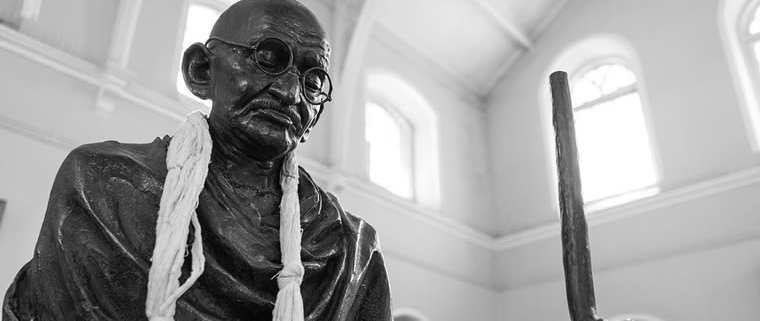
~ Mahatma Gandhi

Press play to hear an audio enhancement as you read.


History does prove that truth ultimately triumphs. But the mills of the Gods grind slowly. Meanwhile what’s our experience of truth?

What is Truth?

Time was when the truth was firmly anchored to “facts.” But here in the era of fake news, the line has blurred been fact and fiction. For many, the truth now relates to their convictions, impervious to analysis or counter opinions.

For those of us seeking a higher state of spiritual experience, what is truth to us? All of us have opinions and, especially when confronted by seemingly outrageous statements (obviously untrue) we can push back… that starts the argument. These days, polarization is at an all-time high and truth is now more anchored to partisan ambition.


In their book, Getting to Yes, authors Roger Fischer and William L. Ury offer a remarkably fresh perspective on mediating differences. They begin by succinctly describing the standard approach, which generally fails everyone. “Each side takes a position, argues for it, and makes concessions to reach an agreement.” 1

This style guarantees everyone loses something. Their alternative, hinted at in the book title, is to begin with an agreement about the intended result. Instead of positional bargaining, they establish a vision of what everyone wants and then work from their different positions towards that destination.

It seems obvious enough that this would be more effective. After all, consider heading out on a trip without knowing where you wanted to go! And it definitely helps if everyone in the car wants to go to the same place! Yet, in life, we often fail to identify a shared destination. Conflict ensues, inevitably.

Liar

What is our intended destination? We might start with ourselves; what do we want personally? Forgetting about big houses, shiny new cars, and the perfect relationship for a moment, what are our deeper desires? Peace, wisdom, love?

And what do we want in the world? Having identified what we want personally, we might notice that we probably want something very similar in the world. So, we already have a powerful insight to embrace: what we want for ourselves we also seem to want for others.

Next step, how do we get there? Here’s a phrase that might help: We experience what we express. In other words, if we want more peace, wisdom, and love – personally and for others – we can express those qualities … and experience them! Seems like magic. And what’s more, our expression of those qualities will likely inspire others to undertake their version of the same. That’s called “entrainment,” where one person’s personal energetic state influences another.


Following this exploration, we realize that “the Truth” is not actually anchored to any position. It’s not a mental concept or a belief. Truth is an experience, the reality of any moment, always aligned with universal truth. So, our actual “position” can always be the same, perhaps stated in these words: “I offer myself to the expression of universal truth.”

And what is this universal truth? Again, it’s not a concept, it’s an experience. We can look to nature, we can look to loving friendships, we can look to successful ventures that include everyone. Truth is not actually a mystery; it’s here, visible, right in the open… if we have eyes to see it, eyes that are not blinded by our conceptual positions.

What a stark contrast this presents in a world where lying has become a well-rewarded tactic. Some of us may be following the political soap opera here in the U.S. Here’s a recent comment about the President’s personal lawyer, Michael Cohen: “Whatever his past may entail, Cohen’s attorney Lanny Davis insists his client is committed to doing the right thing.

“Cohen ‘has turned a corner in his life,’ Davis said in July, adding, ‘He’s now dedicated to telling the truth.’” 2

That’s a blunt admission that prior to this recent epiphany, Mr. Cohen was evidently not dedicated to telling the truth! Of course, he’s an attorney and attorneys do have an unfortunate reputation for bending the truth. Why? To win the case. Truth is a servant to that outcome and since everyone wants to win, the truth can appear very differently, depending on who is using it.

If we’re serious about representing a spiritually based alternative, we never have any position to defend, only this one position to share, complete with the invitation for all others to share our dedication to the expression and experience of Truth, rather than any of its contentious substitutes.


References:
1. Getting to Yes, by Roger Fisher and William L Ury
2. https://www.huffingtonpost.com/entry/michael-cohen-plea-deal_us_5ad20bd8e4b0edca2cba4685