Love Yourself

Living in the Real World – Part 4 – Loving Yourself

What lies behind us and what lies before us are tiny matters
compared to what lies within us.
~Ralph Waldo Emerson

Press play to hear an audio enhancement as you read.


True self-love is not egotistical, it’s the natural experience of knowing that we are one with Source.

Spiritual confidence emerges the moment we truly love ourselves. This requires being in the present moment because it’s the only place we truly exist. As Emerson said, “what lies behind us” – memories from the past – and “what lies before us,” – dreams of the future – “are tiny matters compared to what lies within us.”

What lies within us emerges moment by moment as the reality of our true selves expressing Source energy. Anything else is arrogant pretentiousness, attempting to be something separate from life. When we fully accept ourselves, knowing that who we are is enough and that we are complete for the moment (but only for the moment, which is, fortunately, eternal) then a deep satisfaction soothes our souls. The search is over.


Humans are naturally ambitious. We’re born with the desire to learn, to grow, to create and experience. But because we’ve disconnected ourselves from life with beliefs of separation and abusive behaviors that have produced disastrous results, personally and globally, we now find ourselves in a dangerous predicament where radical corrective action is required. How can we re-focus our ambition, our drive to fully live, in a more positive direction?

First, we must expand our awareness. That’s what’s happening in these moments as you read. And, it’s natural. In fact, this lies at the heart of desire. We have been programmed to want things but we really want depth, the increased experience of a certain kind. What kind of experience, exactly? Love.

There was a popular Country and Western song performed by Johnny Lee called Looking for Love in All the Wrong Places. He sang, “I was lookin’ for love in all the wrong places, lookin’ for love in too many faces, searchin’ their eyes, lookin’ for traces of what I’m dreamin’ of.”

The first place to look is in the mirror. Interestingly, that’s exactly what another famous singer did in a moment that changed her life forever. Queen Latifah remembers, “When I was around 18, I looked in the mirror and said, ‘You’re either going to love yourself or hate yourself.’ And I decided to love myself. That changed a lot of things.”

What lies inside us is … Love! But Love is more than romance, more than an emotion, more even than a state of being. Love is a word that describes the nature of life throughout the universe. Love is the way things are. Yes, countless scientists and science fiction writers believe that the universe is dangerous, that there are malevolent forces out to get us. Why do they believe that? Is there absolute proof? The only irrational threat comes from us! As Walt Kelly, author of the Pogo comic strip wisely said, “We have found the enemy and he is us!”


Self-love is natural because it’s how we experience the delighting, blissful nature of consciousness itself. All of us have touched this, during physical lovemaking, listening to a symphony, marveling at a work of sacred art, being in a holy place, sitting with a true master, or alone in our meditation when our thinking totally stops. We know the experience of Love but our habit is to assign the cause to other people and circumstances.

This misconception is what drives the insanity of The American Dream. We pursue happiness, because it’s something to get… or so the dream says. No. The truth of happiness, of fulfillment, of spiritual enlightenment, of Love, is a reality right now. We live in an all-encompassing environment of unconditional love. What we have touched in moments of ecstasy are not rare incidents to spend the rest of our lives hunting for, “lookin’ in their eyes, searchin’ for traces,” but a blessed emergence into conscious experience of what is always available, and increasingly accessible, as we turn away from the glittering distractions and self-doubt that have obscured the truth of Love.

Now is the moment, this is the moment, Love is here. Remember this the next time you look in the mirror and it will help you make the same choice that Queen Latifah did, to love yourself. Then notice what you see when you do look at others. What will you see? The same love in others that you are feeling for yourself. Because, we are all One.

That tired cliché becomes a vibrant reality when you learn to love yourself.


References:

Feet in pool

Living in the Real World – Part 3 – Enlightenment is Real Now

The path to enlightenment is not long, it’s deep.

Press play to hear an audio enhancement as you read.


As they say, “There’s a seeker born every moment.” But the search is over when we embrace our oneness with God and commit to deepening that experience.

In the last blog we wrote, “Here’s a declaration we might employ: “I am one with all life.” What comes up as you read those words? “Oh, not me, I’m not there yet?” Do you fear that if you accepted those words you would be arrogant and lying to yourself?

Let’s consider the alternative: “I am separate from all life.” Obviously, this is not true because if you were separate from all life, you’d be dead. Your heart is still beating, you’re able to read these words, probably strong enough to walk, you can talk, dream … you’re alive. So, in this state of aliveness, are you one with life or separate from life? What do you believe?


Obviously, as we just proved, believing that you are separate from life is false. In fact, if that belief could manifest fully as fact you would drop dead in that instant. So, can you accept that you are one with life, in fact, but that you are not yet consciously experiencing this, and that the surest sign you are not is your self-doubt?

Repeating our bold declaration, “I am one with all life,” what comes up for you now, a few moments after we began exploring the meaning of this? Probably, something has changed. You may feel slightly more inclined to believe this now. What caused the change? Inquiry. Asking questions. Exploring. But we did this from a place of acceptance, not asking to find an answer to give us something we didn’t already have but using questions to explore something we tentatively accepted could be true.

Letting bird free

Now, just imagine what changes when hesitation turns into confidence! Spiritual confidence is a powerful force. It’s what gurus and masters and teachers have. They radiate certainty, based in their acceptance of the fact that they are, right now, one with all life, and that they are using inquiry to deepen their own experience. The true master is never a finished product but a skilled navigator, asking questions to dive deeper and deeper into the reality of the moment.

Imagine being in a train station. Two trains are ready to depart, each on its own track. One is a train called Searching For Truth, the other is called Deepening My Experience of Truth. Which train will you ride? If you realize you’ve been on the wrong train, it’s not as simple as wishing you could be on the other. The train runs on tracks, even if they’re parallel. It’s moving. It would be dangerous to jump. Right?

If you’ve been on a train you know that they always have an emergency cord. This is for… emergencies. Anyone can pull it at any time and the train will stop. Applying this metaphor to our explorations, can you imagine yourself pulling the emergency cord in your life?


What would it take to motivate such an extreme action. Humans are legendary for denial and procrastination. Some people hack and cough for months but only quit smoking after a terminal diagnosis. How many people promise themselves to work out in the gym, stop eating cake, quit the job they hate, yet continue to suffer in their dishonesty with themselves for years?

Why would you switch trains? Why would you choose to accept that you are one with all life in this moment and proceed to deepen that experience, rather than continuing to seek as one who is not here and not whole and not enough? It’s a question that deserves a moment of serious contemplation.

Woman ecstatic

So, pause as you read these words now. Here’s the question again, edited for impact and presented as an actual proposal: “Will you accept that you are one with all life in this moment and dedicate the rest of your life to deepening this experience?”

Why would you say “Yes!” and follow through? Because you are being touched by the love of God right now, freely offered. You are experiencing the inherent lovingness of life, it’s nature, which is your nature, and you know – in this moment – that this feeling will haunt you for the remainder of your life unless you embrace it and choose to deepen it right now.

Enlightenment is real now.


References:

Young Monk

Spiritual Leadership – Part 4 – Spiritual Mastery

“Masters today, were Starters Yesterday, so begin now.”

~ Bernard Kelvin Clive

Press play to hear an audio enhancement as you read.


Spiritual masters used to live in caves in remote locations. Today, you just might find one when you look in the mirror.

Many people would agree that the Dalai Lama embodies what it means to be an authentic spiritual leader. Two qualities emerge when we analyze what it is about him that generates respect in people around the world: forgiveness and humor.

The Dalai Lama forgives the Chinese for what they have done – and continue to do – to the people of Tibet and to him personally. He is also fierce in his honest commentary about injustice, but he exudes forgiveness. At the same time, he has an infectious sense of humor and is often shown smiling and laughing. Those who have met him confirm that he is a fundamentally happy human being.


If we are inspired by his example, what changes might that trigger in our lives? How might we attain some measure of the spiritual mastery that he demonstrates? We could start by considering the two qualities we just identified and ask ourselves several important questions.

First, what about forgiveness? It can be an excellent healing exercise to create a list of people you feel have wronged you in the past. Write out their names on a piece of paper, without wasting time rehearsing (again!) the epic stories of their misdeeds. Just write down their names and then survey your list. Read each name and say, “I forgive you.”

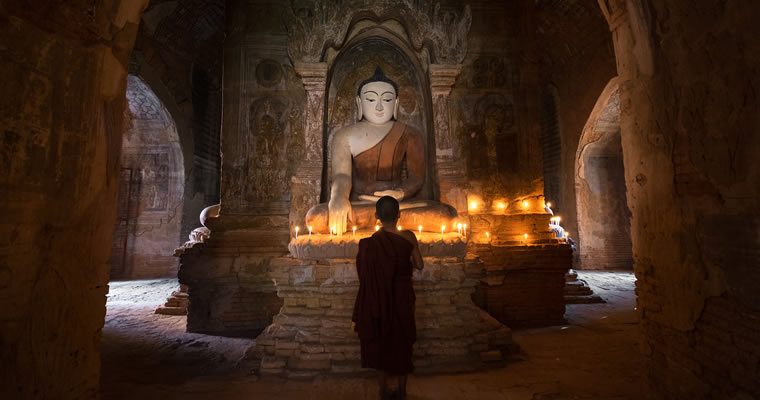
Young Monk with Buddha Statue

What does that accomplish? Not much, usually, because it’s a superficial gesture. Words like this can be largely meaningless; what gives them value is the meaning you deliberately invest in them. So, try it again, this time reading their names and saying, “I forgive myself.”

Now, that may not accomplish anything more significant in terms of real change but it does point in the right direction. The reality of forgiveness is to confront our own judgment and release it. We aren’t condoning someone else’s behavior by doing that, we are simply shifting from hate to love.

All of us get wounded in our interactions and very few adults can honestly recall a childhood without trauma, sometimes inflicted by their own parents. How long will we carry those stories? How long will we maintain a victim identity? How long will we wish for some kind of healing resolution?


Near the end of his life, the sage Krishnamurti gave his followers the secret to his own enlightened state: “Whatever happens, I don’t mind.” Presumably his attitude encompassed past events as well as present ones. Imagine looking back on your own history and feeling free of judgment, regret, anger, and the desire for revenge. That sounds like freedom to me!

Young Monk

If we were unburdened that way, it would open up a vast expanse of space within us, room for others to feel welcomed, just as they are, because releasing judgment of others in the past simultaneously frees us from the tendency to judge others now. Why? Because we recognize, either consciously or unconsciously, that we have no interest in creating new traumatic stories to re-burden ourselves. Once free, who would voluntarily seek enslavement again?

Spiritual mastery is gained, not through inner practice alone, although that is essential. We then take our practice into the world by, literally, practicing. And every moment gives us another opportunity, not just to deal with what’s occurring in caring ways but to release more personal baggage of our own. Why? Connections. Everything happening now is connecting to something that happened before. Nothing exists in solitary isolation. That means that the content of each moment is part of a holistic reality extending across time. When we accept what’s happening now, without judgment, we are also forgiving what happened in other connected moments across the spectrum of our lifetime, without needing to make those connections conscious.

What’s more, we are connecting with the same stream in others. The unburdened presence of a spiritual master works miracles this way, often without words being spoken. The possibilities for transformation and service are unlimited and we can happily spend the rest of our lives exploring the possibilities. Remember, happiness is the second quality we identified in a true spiritual master. Fortunately, as we understand how spiritual mastery works across time, we realize that it’s never too late to have a happy childhood!


References:

Enlighten

Spiritual Leadership – Part 3 – Beyond Location

“Buy land. They’re not making it any more.”

~ Mark Twain

Press play to hear an audio enhancement as you read.


The famous mantra for real estate is “location, location, location.” While that may indeed be the top value priority for real estate, location is increasingly irrelevant in a society woven together by digital technology.

One of the truly disruptive and intriguing innovations in society is the “untethering” phenomenon that technological advances are bringing to an increasingly broad swath of modern life.

This has progressed through telegraph, telephones, radio, television, fax machines, mobile phones, and the internet. Emails and phone calls can originate anywhere in the world; physical locations simply don’t matter. In fact, we have to ask to find out where the person we are conversing is located.


When we consider technological progress like this it’s interesting to ask, “Where did this come from?” A simplistic but consistently accurate answer is, “From inside ourselves.” We invent in the outer world from familiar concepts and structures that already exist inside ourselves.

For instance, we could say that automobiles streaming along freeways are an externalized version of cells flowing through the various circulatory systems within our bodies. The internet is perhaps the best example, revealing a massive connectivity that is pre-dated by the synergistic array of systems inside our individual bodies and also existing in the natural world. Everything is already connected to everything else, as far as biology is concerned. In that sense, technology is catching up, rather than leading the way.

Worldwide

This understanding opens up a unique perspective on the potential for individual impact in a world that seems far too vast for any single individual to exert much significant effect. Regardless of where we are – a small coffee shop in rural Bulgaria or the White House in Washington – we are plugged in (without external wiring) to the whole of the human species plus every other life form that exists… everywhere.

It’s fair to argue that the President of the United States can exert more influence in the world than you or I can. True enough, to a degree. But on another level, he’s one human with one energetic field just like we are. This means that, from a spiritual standpoint, we are all equal, at least in terms of potential. Again, similarly to what we may achieve in the world at large, it’s a matter of actualizing potential. Some people make a mark in the world by activating their innate genius, learning skills, working hard, and creating value. Others watch TV all day and quietly fade away.

We develop ourselves in the material world by expanding our capacities and focusing in the fields where we live and work. We can develop ourselves in the spiritual world by doing exactly the same thing, and that starts with identifying what fields we live and work in on that inner level. This takes us into a consideration of self beyond roles. I am… what? A meditation teacher, a writer, a son, a brother, etc. But I am also a focus of spirit, an essence that is utterly unique. So, what is the nature of my uniqueness?


We can look admiringly at someone like Gandhi or Nelson Mandela and agree they were special beings. Why? Because they actualized their potential. How many others are there who have it within their innate spiritual make up to rise to prominence in terms of social contribution, yet never do because they never get activated?

Untethered

Spiritual seekers are often fixated on achieving enlightenment as a state of being valued for itself. But what about the value enlightened beings bring into the world and, even more significantly, into the milieu of mass consciousness that we all swim in? When we re-frame our spiritual aspirations that way, it becomes obvious that location is entirely irrelevant.

Here’s the moment, here’s the opportunity. It may seem totally insignificant but remember, the greatest destructive power humans have developed occurs through splitting the atom. The most effective homeopathic remedies are those that have been diluted to the point where none of the original physical constituents remain… it’s just energy.

Power resides in the small. So, yes, we are small, rather ordinary individuals. But we do possess the potential to affect significant positive change in the world, one thought, one word, one action at a time, depending on the state we inhabit before, during, and after any of those occur.


References:

Humility Praying

Spiritual Leadership – Part 2 – Spiritual Humility

“Pride makes us artificial
and humility makes us real.”

~ Thomas Merton

Press play to hear an audio enhancement as you read.


Authentic spiritual teachers are always humble because they are living in oneness and that experience overwhelms the ego’s constant need for self-inflation.

The journey of spiritual mastery travels a road of deepening personal humility. Christ said, “I of myself do nothing, the Father within, he doeth the works.” This is the teaching that inspires humility, acknowledging that whatever value any of us might have doesn’t originate in ourselves but flows through us as an expression of Source energy.

It’s ironic that Christ was attacked for being honest about this primary relationship. His humility in oneness was mistaken for arrogance in disconnection by those who were experiencing exactly that themselves. Claiming to be God, as he was accused of doing, certainly will seem arrogant to those who are busy maintaining a prideful ego identity separate from God. Oneness dissolves that polarized separation into what was described as “I am that I am.”


Spiritual humility is wonderfully exemplified by the Dalai Lama who manages to come across as a simple, almost ordinary human being who simultaneously offers words of wisdom and provides a remarkable example of forgiveness in action.

This recalls other prophetic words: “He who would be greatest among you, let him be the servant of all.” The Center for Servant Leadership explains it this way on line: “A servant-leader focuses primarily on the growth and well-being of people and the communities to which they belong. While traditional leadership generally involves the accumulation and exercise of power by one at the “top of the pyramid,” servant leadership is different. The servant-leader shares power, puts the needs of others first and helps people develop and perform as highly as possible.” 1

Humilty in a red dress

I would submit that this definition only covers half the picture. What is it that the servant leader, described this way, is drawing upon for his guidance? We can admire those brilliant leaders who combine inborn intuition with developed skills and understanding but there’s another component being overlooked here, namely the connection with Source (however named).

The spiritual leader is connected to Source and is therefore able to access the coordinating wisdom that prevails throughout the natural world, that is, everywhere that humans haven’t yet succeeded in disrupting. Here is the real example of successful leadership, millions upon millions of species and systems operating synergistically, not just here on earth but throughout the many universes.

It’s indeed humble to acknowledge this organizing intelligence and open to its guiding wisdom. We might even say that it’s common sense, except this attitude is so rare we would need to call it uncommon sense! We humans are highly accomplished in ignoring the obvious and here is the prime example. Of course, it’s symbolized by our incredible ignorance surrounding energy. The entire planet runs on solar energy yet we’ve only recently realized that we could tap into that source, instead of digging up toxins to burn and further pollute the world and sabotage our own health.


But it’s never too late to see the obvious. Through humility, we can access our greatness, which is not merely personal but inexorably connected to the essence of life in everyone and everything. Some leaders are acknowledged as team players; here is the ultimate team to play on: including everyone and everything!

Humilty in a red dress from behind

In sports, it’s generally acknowledged that personal greatness relates as much to how a player performs when he doesn’t have the ball as to when he does. The team player is always looking to play together, rather than to just excel on their own. That’s something to remember as we move through the day and enjoy our various relationships. We’re all on the same team. Spiritual leaders remain plugged in to Source and flow with life, abiding in an expanded state that enables them to help others grow the same primary relationship.

That’s entirely different than those brilliant egos who inspire followers to help bolster their personal greatness at the expense of their own blossoming. Ultimately, the spiritual leader becomes almost invisible, a felt presence that – like the wind – creates an effect without drawing attention to itself. That potential exists in every moment. The question is, will we rise to the opportunities that present themselves to be true spiritual leaders?


References:
1. https://www.greenleaf.org/what-is-servant-leadership/

Spiritual Leadership – Part 1 – The Simplicity of Spiritual Leadership

“Spiritual leadership is the power to change the atmosphere
with one’s presence.”

~ J. Oswald Sanders

Press play to hear an audio enhancement as you read.


All genuine spiritual leaders can teach without words because their real power resides in who they are, broadcasting from them in every moment as an entraining influence on everyone and everything around them.

There’s an old saying: “Who you are is speaking so loudly I can’t hear what you’re saying.” All of us are transmitting the qualities of who we are, whether we’re talking or silent. In fact, often the most meaning we convey lies between the lines, carried in our mere presence.

We all know people who change the room when they enter. And many of us have studied with spiritual masters whose presence changed us, simply by sitting with them in meditation. What’s required in the 21st century to meet the escalating challenges of modern life is not more masters meditating with their thousands of followers but thousands of authentic spiritual leaders circulating in society, emanating qualities that can influence everyone they contact in positive ways.


Walt Kelly had his cartoon character Pogo say, “We have met the enemy and he is us.” Conversely, we could say that “We have met the help we need and he is us.” It doesn’t in any way diminish the irreplaceable value of a true spiritual teacher to suggest that the deliverance we really need is found by looking in the mirror.

Who do we see in the mirror? An ordinary person who needs saving, or a powerful (or potential) spiritual leader poised to turn every moment into something meaningful? It may seem a stretch to consider yourself a spiritual leader but, according to the definition in the opening quote, you already are. We all are, because everyone changes the atmosphere with their presence. It’s unavoidable. The question is: what kind of change do we create?

Effective spiritual leaders uplift others by entraining them in their illuminated energy field, which they ensure remains inspiring and compassionate. This happens through devoted daily practice, not just sitting for meditation but through every day acts of loving and intelligent contribution.

Consider for a moment how you might describe your own energetic field. Some may think of themselves as peaceful and happy but for many an honest evaluation could include descriptors like anxious and fearful. Obviously, all of us would prefer to be happy rather than fearful, but in that disrupted state we tend to focus on benefits for ourselves.

That kind of selfishness further diminishes our power to positively impact others because it is an attitude that is contrary to the way life and Love flow throughout the universe. The urge to help others is not just a humanitarian value, it’s natural for us all and we know that we are happiest when we are helping others.


This changes our perspective on personal improvement. It’s obviously important to continue growing as a person, to mature in our spiritual evolution, but not just for our own benefit. We become spiritual leaders when we expand to consciously care about our impact on others and maintain our own energy field in good order because we want to be as effective as possible with our own entrainment.

All of us can become spiritual leaders this way and can exert our influence where it is needed most, right in the thick of our everyday lives. Yes, we will continue to meditate on our own. Some of us will engage with teachers to deepen and accelerate our progress along the path of awakening, but all of us can embrace this responsibility to lead by example – not just in what we do but in who we are, through the qualities we maintain moment by moment, which creates the energetic impact we have in the world.

Of course, the entrainment provided by any true spiritual leader is not limited by space and time. In this eternal moment, each of us is emanating our signature qualities to affect the whole world and everyone in it. That’s a powerful understanding and can inspire us to be ever more fully the authentic spiritual leader we are destined to be.


REFERENCES:

End of the Road

Beginnings – Part 4 – The Beginning of the End

“Spiritual growth involves giving up the stories of your past
so the universe can write a new one.”


~ Marianne Williamson

Press play to hear an audio enhancement as you read.


Imagine surrendering the stories of your past that have defined who you conceive yourself to be and trusting a greater intelligence to script the rest of your life. This would mark the beginning of the end.

There’s a joke about a man who falls off a cliff and clutches at a branch, hovering above a thousand foot drop. He cries out, appealing to God for help. A voice booms down: “Let go.”

The man takes this in, thinks for a moment, then says: “Is there anyone else up there?”


Letting go is not a popular piece of advice, even on the spiritual path where the words are often used but not always followed with enthusiasm, especially when it involves letting go of who we have conceived ourselves to be. But who is that self? Do we really expect self-improvement of that self can deliver what we hunger for?

Those who debate the relative merits of doing vs being miss a third component, the space between these two polarities. There is something more, a space between that watches both. This can be a ground breaking understanding for those “on the path,” because it doesn’t position being above doing; it emphasizes a witnessing state beyond either polarized aspect of human, egoic identity.

Witness

As one abandons both aspects of human identity in favor of adopting and sustaining a witnessing consciousness, this space grows. It continues to dilate and your experience becomes more dominantly one of “consciousness watching.” Your awareness expands, delivering a more unified experience, regardless of the outer circumstance.

“Space” is the transformative ingredient. Here in the information age, where our personal processing speed continues to accelerate, we are suffocating in an overwhelm of data, 24/7. We are becoming more fragmented, more depressed, and more anxious. In fact, it’s no exaggeration to suggest that we now find ourselves in the midst of a mental illness epidemic.

This is impacting students, particularly. In response, universities are adding more counsellors. But the more they add, the longer the lines of students needing help become. Counselling is not the answer for students who are plugged in every waking moment, eating junk food, and not exercising. Space, space between being and doing, that’s what’s missing. Wisdom emerges from that space, with momentary, timely direction for how to live a balanced life.


From a fully awakened perspective, those two polarities are already balanced so the speed of information processing is not a problem. Everything, including you, is part of the same consciousness. In truth, there is no conflict and no stress and no fragmentation. In fact, it’s possible to reside in the midst of seeming chaos with an awareness that it is all the same, that nothing is wrong and needs fixing, that you are already who you are. You just need to let go.

Don’t suggest that to the scientists fretting about the potential dangers of artificial intelligence (A.I.) To many, biology and technology are in a race to some sort of finish line that will determine the future of humankind. Actually, some would further clarify that it’s about whether humans actually have a future. But consciousness is one and includes everything, including technology. Technology is a valid instrument of consciousness, meant to support you in your further ongoing evolution in consciousness, not sabotage you.

The old human story is that technology and biology are separate, different, and competitive. As you awaken in this space of witnessing oneness, it becomes clear that technology is part of the same consciousness as biology and that the two must coexist. But we are living in the dark ages of consciousness, what in Sanskrit is referred to as the Kali Yuga, where the majority of the human population remains unawakened. That explains the escalating fear about technology as a threat.

Kali Yuga

Modern shamans will tell you that we are in the final stages of the Kali Yuga, the darkest depths of unconsciousness. Their traditional perspective holds that ten avatars show up throughout the four ages but there is only one in this last age. He or she – known as the Kalki avatar – has not yet appeared.

Or, is that too an illusion, or at least an imperfect interpretation? Perhaps the last avatar is a collective one. Perhaps the one we are waiting for is “the one,” the realized state of oneness that emerges as we release our separate human identities. Perhaps our destiny is to let go and soar, not fall. Of course, there’s only one way to find out!


REFERENCES:

Meditation on the World

Beginnings – Part 3 – Wakeful Nothingness

“The wakeful state tells us that the world is not an inanimate place, that matter is not the only reality. It tells us that consciousness is not just produced by the brain but is a fundamental quality of the universe that channels into our own individual beings. It tells us that we are not isolated individuals but share the same spiritual essence as every living being, every object, and the universe itself.”

~ Steve Taylor, from The Leap

Press play to hear an audio enhancement as you read.


Being awake is fundamentally different than being asleep or the in-between stage of waking up. But applying the metaphor to spiritual awakening can be problematic because spiritual awakening delivers us, not to more content the way waking up in the morning does, but to less content, to a state described by the words “wakeful nothingness.”

We use words to venture descriptions of the indescribable. For instance, these words – wakeful nothingness – represent an attempt to describe the state of balance natural to those who are spiritually awake. This is an experience that must be known for oneself; words can merely point the way.

Balance, in the holistic model of reality, is represented by the symbol of the cross. The horizontal plane relates to the polarized opposites of subjective and objective, being and becoming. The first priority towards spiritual awakening is to achieve that horizontal balance. Once you become able to sustain that, then the vertical axis actualizes. This traverses between dense and subtle energetic realms, but no substantial degree of vertical balance can actualize and be sustained until the horizontal balance first locks in. This emphasizes the importance of our daily living experience of wakefulness, not just our meditative practice when sitting.


Working towards the experience of wakeful nothingness is not something that you try to do. It happens courtesy of the orchestration of consciousness and the evolving momentum of your consciousness is the causative force. This experience will emerge for you, for anyone, at the precise moment it becomes the experience whose time has come. Along the way, egoic remnants can sustain a sense of false “doership.”

“Look at me, I’m making great spiritual progress” is a neon sign that proves the ego is still running the show. This fraudulent aberration must dissolve and can – not through any effort on the part of a “seeker” but in the alchemical gap that appears in your awareness between illusion and truth. That gap develops as you cease being identified with what’s happening and become a witness to what’s happening. That’s the key to achieving horizontal balance.

Spiral Mind

In the early stages of awakening many people report various kinds of phenomena. It’s important to clarify that this is the kindergarten stage of awakening consciousness, the early stages of the awakening experience. Epiphanies and magical moments get your attention. You may perceive something radically unusual, complete with vivid lights and colors, etc. That’s interesting, fascinating, often inspiring. And, it’s potentially distracting.

As you continue waking up, the phenomenal fades and the noumenal increases. Your attention is inevitably drawn away from the extraordinary and into the secret magnificence of the ordinary, into what all the great mystical traditions have emphasized: wakeful nothingness. The Gnostics respected this as the ultimate reality of consciousness and genuine teachers warn against letting phenomenon of any kind distract.

Phenomena of consciousness is the noisy part of the mental dimension, all your thoughts, beliefs, and stories. Post-awakening, you begin to perceive more truthfully and your stories shift from life-negative to life-positive, to truthful stories of unified consciousness that are love based.


You could say that your life story progresses from fiction to non-fiction, from noise to silence. In fact, your stories, thoughts, and beliefs reduce themselves to one essential story: There is only one.

Your dominant state of being in life becomes a formless, empty stillness. This explains why all great teachers say, “Watch your stories.” They ask, “Can you be a witnessing consciousness, watching without any opinion?”

World Meditation

Imagine surrendering your opinions. That might seem impossible. But we might well ask, “What’s the value of opinions?” Yes, we can argue concepts, we can defend positions, we can advocate actions. But we can accomplish even more (and a lot easier) without opinion.

In that witnessing stillness, you’ve entered a medium of revelation where what’s seen, known, and realized can be fully embraced, as the way it is and must be. As inadequate as any words are to describe this experience, perhaps these words are sufficient to inspire trading fascination with phenomena for the ego-annihilating reality of wakeful nothingness.


REFERENCES:

New Growth

Beginnings – Part 2 – The Long Year

“And now let us believe in a long year that is given to us, new, untouched,
full of things that have never been, full of work that has never been done,
full of tasks, claims, and demands; and let us see that we learn to take it
without letting fall too much of what it has to bestow upon those
who demand of it necessary, serious, and great things.”

~ Rainer Maria Rilke

Press play to hear an audio enhancement as you read.


As this new year begins to unfold, what’s possible? Will 2018 be more of the same or can this be a breakthrough year, full of those “necessary, serious, and great things” that Rilke speaks of? For that to happened, we first must abandon our belief in a “new year.”

It’s certainly hard to dispute that there is a past, present, and future. We can remember the past, we’re experiencing this right now, and we anticipate there will be a tomorrow. Time repeats itself every day. The sun rises and sets, light dispels darkness, then darkness returns, then light again.

This is the way of the manifested world. But from truthful perspective, not just philosophically but according to quantum researchers, linear time is a human invention that simply doesn’t apply to what reality really is. In fact, the “now” is always new, it never repeats. In that sense, there is no history and no future, there is only now.


Veteran meditators know well the experience of detached, vivid present moment awareness traditionally described as “The Holy Instant.” The Course in Miracles defines it this way: “The holy instant is the instant outside time in which we choose forgiveness instead of guilt, the miracle instead of a grievance, the Holy Spirit instead of the ego. It is the expression of our little willingness to live in the present, which opens into eternity, rather than holding on to the past and fearing the future, which keeps us in hell.” 1

Making those choices means that we can culture this experience. But it could inadvertently suggest that experiencing The Holy Instant is a result of something we do. That raises a pivotal question: who is this “we?” Who am I, who are you? If we are humans weary of the rat race and looking for techniques to enjoy life more, while remaining who we accept ourselves to be, then the whole endeavor could prove to be ultimately distracting.

Centering

For instance, there are meditation teachers who begin their guided journeys with the suggestion to “center yourself.” On one hand this is a simple instruction that makes sense. Close your eyes, breathe, center yourself. On the other hand, who is the teacher speaking to? The one who is not centered. Is that one capable of being centered? Only in theory. In practice, you – the true you – is always centered. You just don’t know it.

So, a better instruction might be to relax into the experience of being centered which you have been too busy to notice. Obviously, that’s too many words for any kind of meditative journey but there’s an important distinction here, namely: you are already the you that you seek. In fact, if you are trying to “find yourself,” you are deluded and will never succeed, because the one who is looking is not who you are.

The early signs of authentic experience of Self shows up as a somewhat detached experience. You let go, you release identification with the illusion of linear time and space. Detached witness consciousness first emerges in the subtle dimensions, particularly through the third eye center. A space emerges in your experience between subject and object. That marks the beginnings of wakefulness or witness consciousness. Most people have had at least a few glimpses of this, momentary experiences of The Holy Instant. This space opens up and you feel yourself to be an observer, rather than identifying with what you are observing.


As you sustain your experience beyond mere fleeting glimpses and become consistent, your consciousness evolves to expand your awareness of the more subtle causal and super causal dimensions. Now your observation becomes more unified. A new experience dawns in you, as the witness and the witnessed are perceived and known to be one and the same consciousness.

We begin lost in an illusion of separation that progressively dissolves. Paradoxically, increased separation precedes increased unification. We wake up from the dream of ourselves as separate by become consciously aware of our separation. This allows subtle ranges of awareness to open, but they remain sub-dominant. As they increase towards dominance, the dense experience of separation yields and we “discover” – or we might say “remember,” who and what we have always been. This is profoundly different than hopes for enlightenment that leave your egoic identity in place, the same but improved somehow, like a spiritualized version of your illusory self.

Rilke spoke about a “long year.” Perhaps we can embrace that term as a good descriptor for the sustained experience of The Holy Instant, that delivers what all humans hunger for, the timeless experience of “I am.”


REFERENCES:

Girl Questioning

Beginnings – Part 1 – What If?

“It’s the best possible time of being alive, when almost
everything you thought you knew is wrong.”


~ Tom Stoppard

Press play to hear an audio enhancement as you read.


What if almost everything you’ve assumed to be true was false? And what if things were much better than you thought?

Ignorance is bliss. So wrote Thomas Gray, an eighteen century English poet. Was he right? Yes and no.

We can’t miss what we’ve never had, it’s true. In that sense, ignorance is bliss. On the other hand, if we don’t know how to experience fulfillment we can’t be happy. In that case, ignorance is definitely not bliss.


It’s easy to get confused about life right now. We’re assaulted 24/7 with “news,” which should really be called “olds,” because it’s always a report on the past. And, it’s almost always bad. We swim in negativity. It’s addictive. It’s seductive. And it can convince us that the world is going to hell in a hand basket, as the saying goes. Who wouldn’t like even a few changes for the better?

We’ve recently celebrated the end of one year and the beginning of another. Out come the New Year’s Resolutions and, at least for a few weeks, hopes run high that this will be the year of change. Finally, we will lose weight, get that promotion, find the perfect partner (or our current partner will magically change). We might even hope to make great progress towards spiritual enlightenment.

Chalkboard

“But, it’s very rare you’ll keep your resolutions for the whole year. According to U.S. News, approximately 80% of resolutions fail by the second week of February, so the odds are against you.” 1

It’s easy to blame ourselves for a lack of discipline, for reaching too high, or for simply losing our motivation. But there’s a deeper issue at the heart of our chronic failure to create newness and sustain change – a misunderstanding of what it means to begin.

Why do we make New Year’s Resolutions in January? Because it’s a new year. Really? Who said so? Well, the calendar for one. But does that make it so? Only if we agree it does. The Chinese don’t. Their new year begins February 16 this year. Is someone right and someone else wrong? No, it’s just a matter of different perception and beliefs.


If that’s the case, we might want to experiment with being proactive about beginnings. In other words, invent our own. For instance, this is a beginning right now, as I write and you read. Why not? You can decide it is and so can I. But to do so, and to make it stick, we will likely struggle against our own convictions and assumptions. After all, there’s nothing special about this moment. Or, is there? How might we make it easier to render this moment unique and worthy of eager exploration?

Actually, we’ve already experienced this … when we were babies, when everything was new. What was, simply was. We didn’t compare, we couldn’t, because we didn’t have the developed capacity. It wasn’t Wednesday (again), it was just another moment of being alive and exploring whatever showed up.

As adults, we don’t enjoy the luxury of hanging out moment to moment and having our every need provided for. We’re responsible for making a living and caring for ourselves and our families. Unfortunately, that means that we tend to lose touch with the novelty inherent in being alive in each simple moment.

Planning

Many of us agree to work from Monday to Friday. Then we do something different, but often predictable, on the weekends. Even our vacations might be fully planned. In other words, we stay busy inventing sameness.

What if we quit? Sure, we might have contemplated this question at work. Or, in our marriage. Sports fans might get fed up when their team loses too often and consider suspending their support. And most of us have bailed on a movie or two when it failed to deliver what the trailer promised. So, this is a habit we all understand. But we probably haven’t applied it to a much larger challenge, you could say a universal one: quitting the lie of assumed sameness.

In fact, there is no valid reason why we can’t make this moment a beginning and invest it with our full passion for joy and fulfillment. We can jettison our well-worn excuses, if we choose. You know them as well as I do: I’m too old, too young, don’t have enough money, there’s something wrong with me or my partner, we elected the wrong President, etc. The alternative? Quit complaining, accept the way things are, and create the life experience we prefer.

Jumping the Gap

What about all the obstacles? Well, have you ever seen a tree growing out of a rock, or a plant erupting through pavement? That’s what life innately does and, one imagines, without complaint.

A whole new vista of experience can open for us, the moment we choose to become the author of our experience rather than a spectator. Sages call this The Holy Instant. If that sounds appealing, well, here it is, never more (freely) available than right now in this very moment.

What if?


REFERENCES:
1. http://www.businessinsider.com/new-years-resolutions-courses-2016-12